Condominium Incentives 2026: which bonuses to leverage to increase value
by Marco Balistreri · · 5 minute read
In Turin and throughout Italy, those living in or investing in a condominium need to know the condominium incentives 2026 to decide which works are worthwhile and how these increase the property value. This article explains the main incentives available for common areas, key requirements, how deductions are shared among co-owners and how to plan the intervention to maximise economic return.
In brief
- Renovation bonus: 50% IRPEF deduction for main residence and 36% for others, up to a spending cap of 96,000 euros per property unit.
- Ecobonus and sismabonus: in 2026 they apply to common parts with rates of 50% (main home) and 36% (other units), with conditions on the Energy Performance Certificate (APE) and technical certifications.
- Bonus for lifts and barrier removal: now included in the ordinary scheme (50%/36%); reduced VAT may lower intervention costs.
- Procedure and documentation: urban and cadastral compliance, assembly resolution, detailed estimate and invoice retention are essential to obtain deductions.
Which condominium incentives 2026 are worth knowing
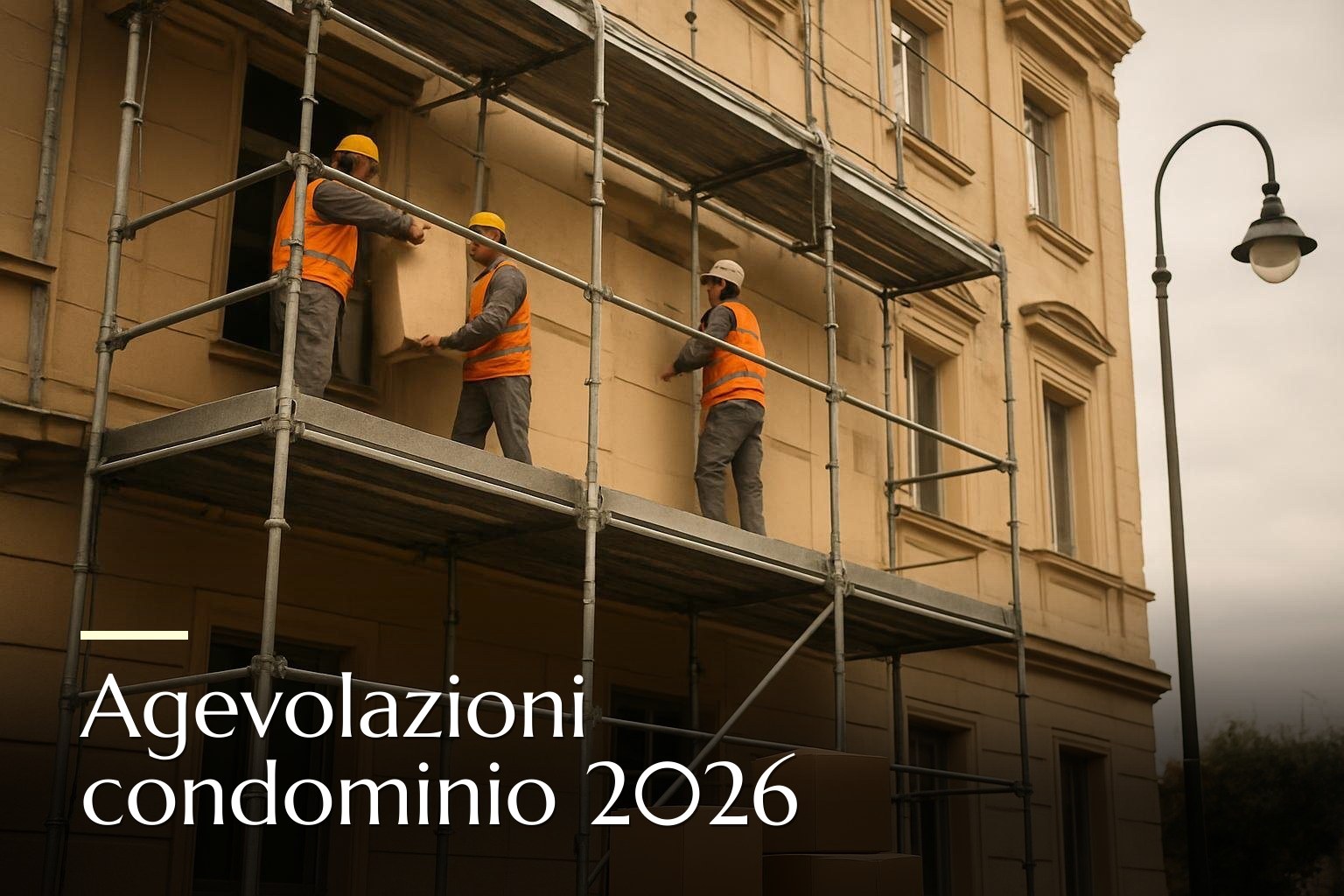
The condominium incentives 2026 focus on three types of incentives useful for interventions on common parts: the ordinary renovation bonus, the ecobonus for energy efficiency and the sismabonus for seismic risk reduction. In Turin these tools are the most used when the condominium needs to renovate facades, systems, roofs or upgrade lifts.
Renovation bonus: what it covers and how it is allocated
The renovation bonus covers extraordinary maintenance works on common parts: façade refurbishment as part of broader works, structural strengthening of staircases and roofs, upgrading of centralised systems. The deduction is granted individually to each co-owner in proportion to their share and is spread over ten annual instalments. The spending cap is 96,000 euros per property unit, so practically the condominium must multiply this cap by the number of units to estimate possible coverage.
Ecobonus and sismabonus: investing to save and enhance value
The ecobonus rewards interventions that improve energy efficiency (thermal insulation, high-efficiency heat pumps, replacement of centralised systems with more efficient ones). In 2026 the applicable rates follow the ordinary regime distinguishing main homes and others; it is essential to prove the energy performance leap with APE before/after works and, for some types, provide technical certifications. The sismabonus requires certification of the seismic risk class achieved after the works: it is particularly relevant for condominiums in risk zones around the Apennine belt, but also for parts of Piedmont where structural checks are required.
Lifts, architectural barriers and greenery: what changes in 2026
The 75% reduced rate for removing architectural barriers is no longer in effect since 2026; now these interventions fall under the ordinary renovation bonus. For installation or upgrading of lifts in condominiums the deduction is the base rate (50% or 36%). It is still useful to consider reduced VAT: for certain services and supplies related to barrier removal this can be lower, reducing immediate costs.
Who can benefit and what documents are needed
In Turin, as in the rest of Italy, each co-owner who has actually borne the expense and is explicitly named in the invoices or has paid their share through traceable methods can benefit from the deduction. For incentives, the building must have full urban and cadastral compliance: irregularities or unresolved violations block access to bonuses. Assemblies must approve the works with minutes, supported by a detailed cost estimate and separate accounting for incentivised expenses.
Planning condominium works: order of priority and impact on value
To increase the value of a condominium property in Turin, it is advisable to follow a priority order: first, interventions that reduce management costs (energy efficiency improvements), then those that enhance safety (seismic bonus, system upgrades), and finally aesthetic and functional works (facades, lifts, common areas). A well-executed thermal insulation or a more efficient central heating system impacts both bill savings and the building's energy class — two elements highly valued by buyers. For complex works, accompanying a compliance report is helpful: see when it is needed and why.
Financial strategies and payment alternatives
In addition to deductions, condominiums can consider credit transfer or invoice discount only when provided for that specific incentive; many options related to the superbonus are no longer available in 2026. Planning a shared amortisation plan and requesting clear quotes with separate accounting helps to avoid disputes among condominium owners and to meet tax requirements. To explore how the renovation bonus can concretely enhance a property in Turin, this guide may be useful: Renovation Bonus: Practical Guide.
Frequently asked questions
Who pays and who receives the deduction in a condominium?
The deduction is granted to the condominium owner who has actually incurred the expense and is allocated according to ownership shares, provided the payment is traceable and invoices are correctly addressed. The condominium assembly must approve the works and the cost allocation.
Can I use the bonus if the condominium has building irregularities?
No. The urban and land registry compliance of the entire building is a necessary condition to access incentives; unresolved violations may prevent the right to the deduction.
How does the ecobonus affect the market value of an apartment in Turin?
An energy efficiency intervention that improves the APE class and reduces condominium costs increases the property's desirability and can result in a higher sale price or greater rental yield, especially in central and residential districts of Turin.
Is it better to do thermal insulation or replace systems before selling?
It depends on the building's condition: insulation visibly improves the energy class and attracts buyers sensitive to energy savings; system replacement is often less invasive and may be quicker to execute. Consider costs, available deductions, and timelines with a technician.
Practical advice: before resolving, request a detailed quantity survey and multiple quotes from different companies in the assembly; verify the building's cadastral and urban regularity and keep all documentation (invoices, bank transfers, certifications, APE) in case of inspections. If you want tailored advice for your condominium in Turin, contact us for a free technical and tax consultancy.
Do you have questions about this topic or your property?
Talk to us